

Last updated: October 2026
Every fall, lab managers face the same problem: there is money left in the year-end lab budget, the fiscal year is closing, and anything unspent may disappear or shrink next year’s allocation. The temptation is to buy whatever ships fastest. The better move is to spend with a plan, so the dollars you commit in the final weeks of the year improve throughput, uptime, and capability for the next twelve months.
This guide covers how to identify your real deadline, decide what to buy, stay inside grant and accounting rules, and build a delivery timeline that works. It also explains where used lab equipment fits, since pre-owned instruments let many labs cover more of their wish list with the same remaining funds.
Key Takeaways
- Your real deadline is your purchasing office’s requisition cutoff, which is usually weeks before the fiscal year ends.
- Prioritize purchases that reduce risk first, then add capacity, then add new capability.
- The federal equipment threshold under the Uniform Guidance is now $10,000 per unit, which changes how some purchases are classified.
- For private labs, equipment generally must be placed in service by year-end to count toward that tax year, and used equipment can qualify.
- Used and refurbished instruments in stock can stretch remaining funds and often ship sooner than new systems.
In this guide:
- Confirm your actual deadline
- Audit your current equipment
- Build a tiered purchase list
- Check grant and capitalization rules
- Understand tax timing for private labs
- Plan your timeline backward
- Why used lab equipment fits year-end purchasing
- Turn idle equipment into next year’s budget
- Year-end lab budget checklist
- FAQs
Step 1: Confirm Which Year-End Deadline You Are Up Against
“Year-end” means different things depending on who funds your lab. Before you build a purchase list, confirm the exact date your purchasing office needs a signed PO, an invoice, or a received item.

Common fiscal year-end dates. Your requisition cutoff is usually weeks earlier.
| Organization Type | Common Fiscal Year-End | What It Means for You |
|---|---|---|
| Private companies, CROs, and biotech startups | December 31 (most common) | Equipment generally must be placed in service by year-end to count toward that tax year. |
| U.S. federal agencies and federal labs | September 30 | FY2027 is underway. Use the first quarter to plan purchases rather than rushing next September. |
| Universities and academic research labs | Often June 30 (varies by institution) | Grant budget periods may differ from the institution’s fiscal year. Check each award’s end date separately. |
| Hospital and clinical labs | Varies by health system | Capital committees often meet on a fixed schedule, so internal approval may be the real bottleneck. |
Ask your purchasing or finance team one specific question: “What is the last day I can submit a requisition and still have it charged to this fiscal year?” That date is usually several weeks earlier than the calendar end date.
Step 2: Audit the Equipment You Already Have
The smartest year-end purchase is often the one that removes your biggest operational risk. Walk the lab and list every instrument that is:
- Down, or running with recurring service calls
- Past manufacturer end of support, making parts and service harder to source
- Creating a bottleneck because the team is queuing for it
- A single point of failure for a revenue-generating or grant-critical assay
For instruments that still run but are costly to maintain, compare the numbers before you commit. Our guide to laboratory equipment repair vs. replacement shows how to weigh a repair quote against the cost of a refurbished unit.
Step 3: Build a Tiered Lab Equipment Purchase List
Once you know your pain points, sort potential purchases into three tiers. This keeps you focused if funds or time run short.

Sort your year-end lab budget into three tiers and fund them in order.
Tier 1: Risk Reduction
Backup or replacement units for instruments your lab cannot function without. A second centrifuge, a redundant -80°C freezer, or a spare real-time PCR system can prevent weeks of lost work when the primary unit fails.
Tier 2: Capacity and Throughput
Equipment that removes a bottleneck. Examples include an additional HPLC system to clear a sample backlog, a liquid handling system to free up technician hours, or an automated extraction platform to standardize sample prep.
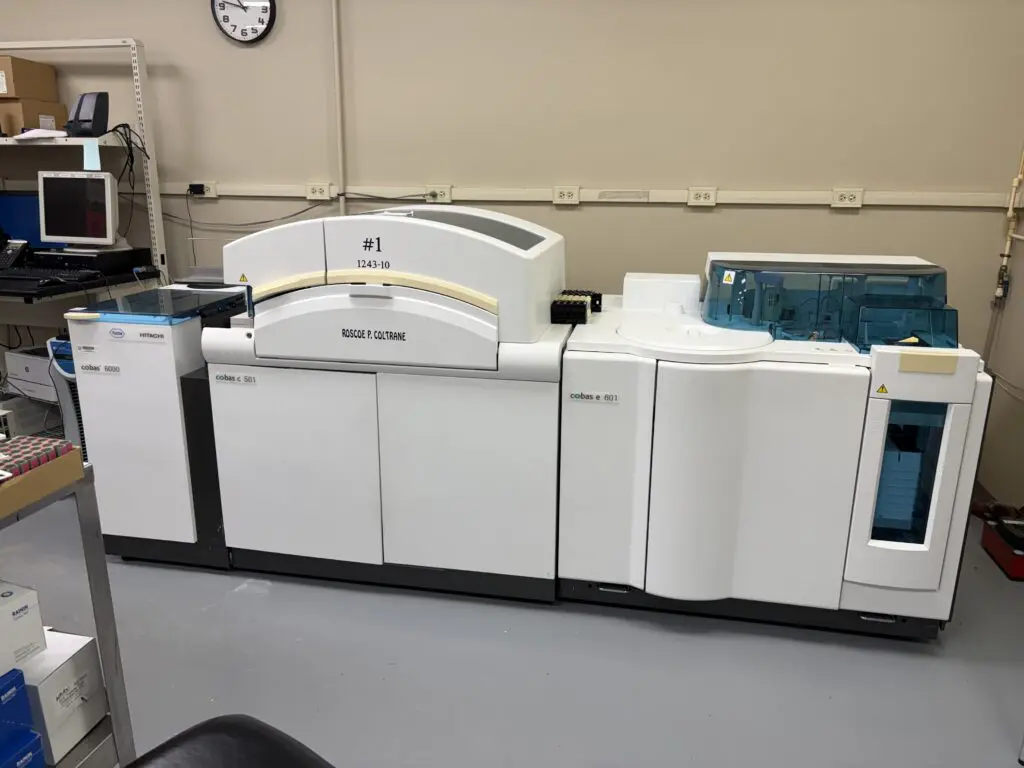
A pre-owned Roche Cobas 6000 chemistry analyzer. Adding a second analyzer is a common Tier 2 capacity purchase.
Tier 3: New Capability
Instruments that let your lab offer a new assay or bring outsourced work in-house, such as an LC-MS/MS system, an ICP-MS system, or a next-generation sequencing platform. These carry the biggest upside but also the longest installation and validation timelines, so start early.
Step 4: Check Grant and Capitalization Rules
Before you finalize anything, confirm how each purchase will be classified. Classification affects approval requirements and which budget line a purchase can be charged to.
- Federal equipment threshold: The 2024 revisions to the Uniform Guidance raised the federal equipment threshold from $5,000 to $10,000 per unit for awards made on or after October 1, 2024 (see the definition of “equipment” in 2 CFR 200.1). Items below your institution’s threshold are typically treated as supplies. Your institution may set a lower threshold, so confirm locally.
- Prior approval: Some awards require sponsor approval for equipment that was not in the original budget. The rules for equipment and capital expenditures are in 2 CFR 200.439. Talk to your grants office before you place the order, not after.
- Allowability: Purchases charged to a grant generally need to benefit that project. Buying an instrument in the final weeks of an award period can draw questions if it will mostly be used after the award ends.
- Used equipment documentation: Pre-owned instruments are generally allowable on grants when properly documented, but some institutions require a written quote, a condition statement, or a cost comparison. Request these from your supplier up front.
Step 5: Understand Year-End Tax Timing for Private Labs
For privately held labs, timing a purchase before December 31 can affect your tax position. Under current federal law, Section 179 allows qualifying businesses to expense up to $2.5 million in equipment purchases (indexed for inflation) for tax years beginning after 2024, and 100% bonus depreciation applies to qualifying property acquired after January 19, 2025. The IRS explains both in Publication 946, How to Depreciate Property.
Two details matter for lab buyers:
- Used equipment can qualify. Pre-owned equipment is generally eligible as long as it is new to your business.
- “Placed in service” is the key date. Paying for an instrument in December is not enough. It generally needs to be delivered and ready for use by the end of the tax year.
Tax rules have limits and exceptions that depend on your business structure and income, so review your plans with your accountant or tax advisor before you buy.
Step 6: Plan Your Timeline Backward From the Deadline
The most common year-end mistake is underestimating how long it takes to go from “approved” to “running.” Large instruments do not ship like office supplies. Work backward from your deadline and account for each of these steps:
- Quote and specification review. Confirm model, configuration, software version, and included accessories.
- Internal approval and PO. Capital requests may need multiple signatures.
- Payment and release. Allow time for vendor setup if the supplier is new to your purchasing system.
- Crating and freight. Mass spectrometers, sequencers, and floor-standing centrifuges often require specialized crating and liftgate or white-glove delivery.
- Site preparation. Check power, gas lines, exhaust, bench space, and door clearances before the instrument arrives.
- Installation and qualification. Regulated and clinical labs need time for IQ/OQ/PQ before an instrument can be used on live samples.

Example timeline for a large instrument. Actual timing varies by instrument, supplier, and purchasing process.
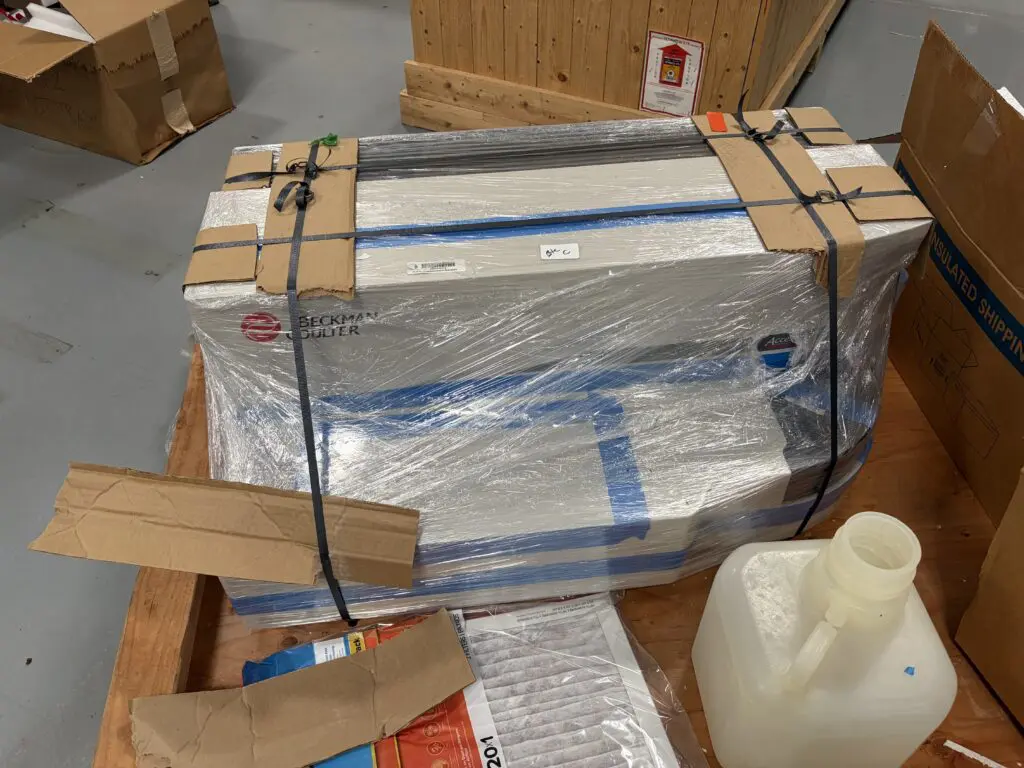
Large instruments ship palletized or crated, so build freight time into your plan.
Holiday weeks shorten every one of these steps. If your deadline is December 31, aim to issue POs for larger systems by mid-November.
Why Used Lab Equipment Fits Year-End Purchasing
Pre-owned instruments are a practical way to cover more of your purchase list before the fiscal year closes. Here is why many labs include them in year-end planning:
- Lower cost per instrument. Used and refurbished systems typically sell below new list price, so remaining funds can cover more of your Tier 1 and Tier 2 needs.
- Available inventory. Units already in stock can often ship sooner than new instruments that require manufacturing or configuration lead time.
- Platform continuity. Buying a second unit of a model your team already runs means existing methods, consumables, and training transfer directly.
- Established platforms. Many instrument types, including HPLC, GC-MS, and real-time PCR systems, have long service histories and wide parts availability.

A pre-owned Agilent 6420 triple quadrupole LC-MS/MS system.
When evaluating a used instrument, ask for the model and serial number, operational status, included modules and software, and any available service or usage history. A reputable supplier should answer those questions clearly before you commit. If you can’t find the exact model you need in stock, Arc Scientific can source specific equipment on your behalf.
Step 7: Turn Idle Equipment Into Next Year’s Budget
Year-end is also a good time to look at what is sitting unused. Instruments that are surplus, duplicated, or replaced by newer systems still have resale value, and that value declines the longer they sit. Selling idle equipment frees up floor space and recovers funds you can reinvest in next year’s priorities.
Before you sell, review our 9 tips for selling used lab equipment to prepare the instrument and document its condition. For larger consolidations or closures, see The Lab Decommissioning Playbook. When you’re ready, you can sell your used instruments through Arc Scientific.
Your Year-End Lab Budget Checklist
- Confirm your real requisition and receiving deadlines with purchasing
- Audit instruments that are down, unsupported, or bottlenecked
- Sort needs into risk reduction, capacity, and new capability tiers
- Verify equipment thresholds and prior-approval rules for each funding source
- Review tax timing with your accountant (private labs)
- Build a backward timeline that includes freight, site prep, and qualification
- Request quotes on used and refurbished options alongside new
- List idle instruments to sell before the year closes
Year-End Lab Budget FAQs
What should a lab buy with leftover year-end budget?
Start with purchases that reduce operational risk, such as backups for critical instruments, then equipment that removes bottlenecks. New-capability instruments make sense if you have enough time for delivery, installation, and validation before your deadline.
Can I use grant funds to buy used lab equipment?
In most cases, yes. Federal awards generally allow used equipment when it is necessary for the project and reasonably priced. Your institution may require extra documentation, such as a quote, a condition statement, or a cost comparison, so check with your grants office first.
What is the federal equipment threshold for grants?
Under the 2024 Uniform Guidance revisions, equipment is defined as an item with a per-unit cost of $10,000 or more (or your institution’s lower threshold) and a useful life of more than one year. The change applies to federal awards made on or after October 1, 2024.
Does used lab equipment qualify for Section 179?
Generally, yes, as long as the equipment is new to your business and placed in service during the tax year. Confirm the details with your tax advisor.
How early should I order lab equipment before the end of the year?
For benchtop items that ship from stock, a few weeks may be enough. For large systems that need freight coordination, site preparation, and qualification, start in October or early November.
Make Your Remaining Lab Budget Count
Arc Scientific connects buyers and sellers of used laboratory equipment, with more than 14,000 items available, including HPLC systems, LC-MS/MS and GC-MS systems, real-time PCR systems, liquid handling systems, and more. Browse the marketplace or contact our team to request quotes on the instruments on your year-end list, and we’ll help you find options that fit your budget and your timeline.